English
Views: 0 Author: Site Editor Publish Time: 2026-07-13 Origin: Site
For B2B buyers and product designers, sourcing reliable extension tools requires a delicate balance. You must constantly weigh rigidity against overall weight. You also need to account for harsh environmental exposure. Generic off-the-shelf options often fail right when you need them most. They might snap at full extension under heavy loads. Sometimes they rapidly degrade in extreme settings, such as high-heat BBQ grills or tight precision inspection environments. We created this guide to help you navigate these specific design pitfalls. You will learn a clear technical evaluation framework for specifying and shortlisting custom manufacturers. By the end, you will understand how to evaluate material integrity. You will also know how to choose the right locking mechanisms. Finally, we will show you how to set application-specific tolerances to guarantee product success.
Engineers often debate between aluminum and stainless steel for tubular products. You might lean toward aluminum to save weight. However, certain heavy-duty applications demand the unique properties of steel. Knowing when to make this upgrade separates professional-grade tools from cheap consumer alternatives.
Stainless steel offers superior yield strength. This property minimizes deflection when you extend the tubes fully. Aluminum tends to bend or wobble under cantilever loads. A well-engineered stainless steel telescopic pole holds its shape. It ensures your operators can apply force at a distance without the tool snapping or bowing dangerously.
Temperature fluctuations destroy weaker metals. This is crucial for BBQ and industrial applications. Aluminum might warp near open flames. It also conducts heat rapidly to the user's hand. Stainless steel resists high temperatures while maintaining structural integrity. It also withstands harsh chemical washdowns better than anodized aluminum.
We must acknowledge an inherent drawback: stainless steel is heavier. However, custom manufacturing solves this problem. Smart suppliers engineer specific wall thicknesses for each nested section. They use thicker walls at the base for strength. They use thinner walls at the tip to reduce swing weight. This precise engineering mitigates user fatigue while maintaining overall strength.
Food processing and medical environments require strict sanitation. Stainless steel provides a naturally non-porous surface. It prevents bacteria from hiding in microscopic crevices. This makes it the undisputed standard for food contact. You can easily sanitize the exterior using harsh industrial cleaners without stripping the finish.
Every industry uses telescoping tools differently. You cannot use a universal design for every client. Manufacturers must adapt the tubing geometry, surface finish, and internal components to match the end-use environment.
Grill tools operate in punishing conditions. You must specify requirements for handling high temperatures. The design must prevent structural failure near open flames. Furthermore, you must control heat transfer to the handle. We recommend inserting thermal breaks or using high-density rubber grips. Additionally, food-grade compliance is non-negotiable. You must ensure the surface finish and base material meet strict sanitary standards. SS304 remains the industry standard here.
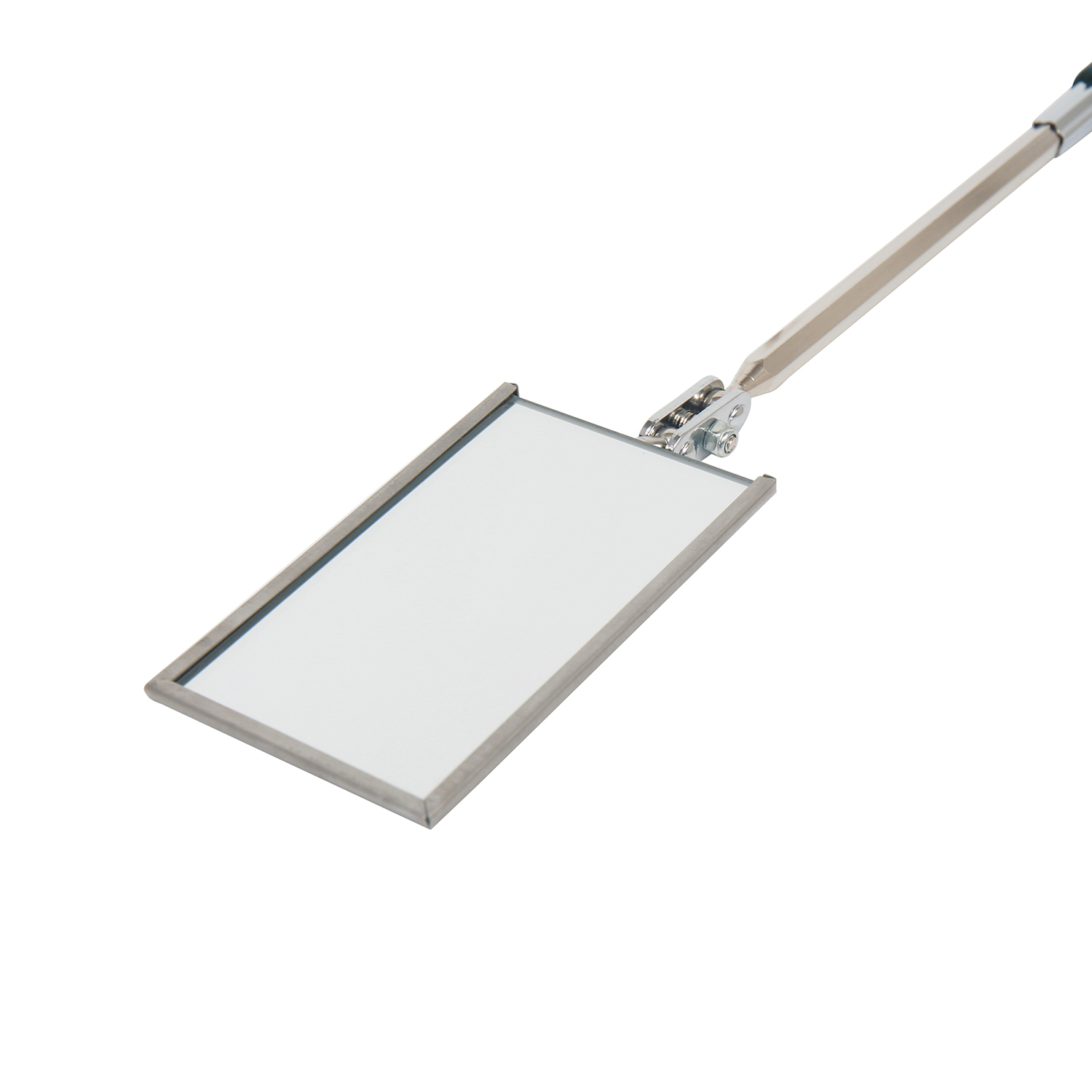
Security teams and mechanics rely on precision optics. They cannot afford a mirror rotating out of alignment. A high-quality stainless steel mirror pole requires specialized engineering. Manufacturers often use grooved tubing. This track system prevents the nested sections from spinning during use. When you design an adjustable inspection mirror pole, you must demand exact positioning. The joints cannot sag. The locking collars must engage firmly so the operator maintains a clear field of view under vehicles or inside tight machinery.
Retrieval hooks and grabbers face extreme dynamic loads. You must calculate the maximum load capacity at full extension. Extending a tool to three or six meters creates a massive bending moment. The base sections must absorb this torque without permanent bending. Attachment security also matters. You should specify custom threading or reinforced tips to handle twisting and pulling forces. Simple glued fittings will fail under heavy retrieval tasks.
Customization involves much more than requesting a specific length. You must dictate the metallurgical composition, the mechanical joints, and the user interface. Overlooking these details leads to premature product failure in the field.
Choosing the correct alloy dictates product lifespan. You must analyze the cost-to-benefit ratio of different steel grades based on your end-use environment.
| Steel Grade | Corrosion Resistance | Cost Level | Best Application Scenarios |
|---|---|---|---|
| SS201 | Low (Prone to rust outdoors) | Budget | Indoor use, light-duty tools, promotional items. |
| SS304 | High (Industry standard) | Moderate | BBQ tools, inspection mirrors, general outdoor gear. |
| SS316 | Maximum (Marine grade) | Premium | Saltwater retrieval, chemical plants, medical devices. |
The joints represent the weakest link in any telescoping assembly. You must select the right lock for the user's task.
A durable tube needs a comfortable handle. You can customize the grip based on the environment. EVA foam provides lightweight comfort but absorbs grease. Rubber molded grips offer excellent slip resistance for wet retrieval jobs. Knurled metal handles provide maximum durability in high-heat BBQ settings where synthetic materials might melt.
The final finish protects the metal. Polishing creates a mirror-like aesthetic and removes microscopic burrs. Electroplating can add specific colors. Passivation is the most critical step. This chemical process removes free iron from the surface. It drastically enhances overall corrosion resistance. Always ask your supplier if they perform acid passivation on their welded tubes.
Even brilliant designs fail during mass production. B2B buyers must anticipate common manufacturing errors. Addressing these risks during the RFQ phase saves thousands of dollars in defective inventory.
Telescoping tubes slide inside one another. If the manufacturer lacks precision, you face tolerance stack-up. Minor dimensional errors compound across multiple sections. If the gap is too tight, the sections jam permanently due to thermal expansion or dirt. If the gap is too loose, the assembly rattles and feels incredibly cheap. You must specify exact clearance tolerances (e.g., +/- 0.1mm) between nested segments.
Some unethical suppliers substitute cheaper materials to pad their margins. You might order SS304 but receive SS201. The product will look identical on day one. However, it will rust completely within three months of outdoor use. You must protect your supply chain. Demand independent material certifications. Request PMI (Positive Material Identification) testing. You should also ask for standard salt-spray test reports (like ASTM B117) to verify corrosion resistance.
Internal twist-locks often rely on nylon or plastic expansion blocks. Friction causes these internal plastic components to wear down over time. Eventually, the lock slips under pressure. You must ask the factory about their component lifecycle. They should provide testing data showing how many extension-retraction cycles the mechanism survives before failing.
Logistics can break your budget. Long-dimension items incur massive shipping penalties. You must factor in the fully collapsed length of your design. A tool that collapses to 1.5 meters might fit on standard pallets. A tool that collapses to 2.5 meters might require specialized freight handling. Consider these logistical realities early. They directly impact your final landed cost.
Do not select a partner based entirely on the lowest unit cost. A reliable factory acts as an extension of your own engineering team. Use this framework to evaluate potential suppliers.
Never rush into mass production. Prioritize suppliers willing to provide custom-tooled samples. They should eagerly build a physical prototype matching your exact dimensional and material specs. This proves they actually control the manufacturing process rather than simply trading pre-made goods.
We look for documented testing procedures. A trustworthy manufacturer will gladly share their internal QC manual. They will show you how they test maximum load capacity. They will share videos of lifecycle tests, proving the locking mechanisms survive thousands of cycles. Transparency builds long-term trust.
Balancing Minimum Order Quantities (MOQ) requires tact. Some premium factories demand massive upfront orders. Others accept small MOQs but lack the machines to scale up if your product goes viral. Ask about their monthly capacity. Ensure they can handle your initial pilot launch and your eventual mass-market rollout.
You must draft a clear, uncompromising Request for Quote. Vague requests yield vague pricing. Detail the exact collapsed length and the fully extended length. State the target load requirements (e.g., "Must hold 5kg at 3 meters horizontally"). Describe the application environment clearly. This clarity forces suppliers to engineer real solutions rather than guessing.
Sourcing the right custom telescopic pole transitions a product from feeling cheap to feeling professional and durable. You must balance the structural demands of the task against environmental hazards like heat or saltwater. We strongly advise buyers to focus on locking mechanisms and material grades as primary success factors. Base your supplier choice on their engineering communication during the RFQ phase, not just the lowest unit cost. A good partner will point out design flaws before cutting metal. We encourage you to finalize your dimensional specifications now. Reach out to a vetted manufacturer and request a material-certified sample today.
A: Practical limits usually sit around 6 to 8 meters for manual hand tools. Going beyond this requires a significantly larger base tube diameter to prevent extreme bowing. Weight also becomes unmanageable for a single user at these lengths. For extreme reach, suppliers must engineer custom wall thicknesses.
A: Yes. High-quality manufacturers offer extensive end-fitting customization. You can specify standard threading, quick-release locking pins, or welded brackets. This ensures your mirrors, cameras, or specialized optical tools attach securely without spinning loose during tight mechanical inspections.
A: Reputable suppliers use Positive Material Identification (PMI) testing. They scan the metal with a handheld XRF analyzer to verify the chemical composition. They should also provide official material test reports (MTRs) from the steel mill, proving the exact percentages of chromium and nickel.
A: Standard industry timelines average 15 to 25 days for custom tooling and initial prototypes. Once you approve the physical sample, mass production generally requires an additional 30 to 45 days. You must factor in transit times if ordering globally.