English
Views: 0 Author: Site Editor Publish Time: 2026-06-29 Origin: Site
Procurement for industrial tooling carries incredibly high stakes for facility managers and engineers. Equipment failure at height often results in immediate safety hazards, severe operational downtime, and expensive replacement costs. We know the immense pressure you face to source dependable, rigorous, and safe hardware. This guide provides a strictly technical, application-based framework for evaluating and sourcing industrial-grade telescopic poles. You will learn exactly how to analyze structural integrity and compare various material grades. We will also break down locking reliability to ensure seamless integration into your existing workflows. By the end of this article, you will possess a solid roadmap to avoid common procurement pitfalls and secure the exact hardware your specialized team requires.
Engineers often debate the merits of aluminum, carbon fiber, and fiberglass. Let us frame this problem objectively without relying on exaggerated marketing claims. Each material possesses distinct mechanical properties. Carbon fiber offers incredible stiffness and extreme lightweight advantages. Fiberglass provides excellent electrical insulation. However, industrial environments routinely subject tools to harsh physical abuse. You must evaluate how these materials respond to real-world impacts.
Aluminum remains the industry standard for rugged, high-impact scenarios. It delivers an unmatched cost-to-durability ratio. Carbon fiber might shatter or crack under lateral crushing forces. Heavy machinery easily damages composite tubes during transit or accidental drops. Aluminum simply dents under similar stress. It maintains structural integrity much longer after sustaining minor physical damage. This predictable failure mode prevents sudden catastrophic snapping during critical operations.
We must also transparently state aluminum's limitations. Metal conducts electricity easily. This inherent characteristic makes it entirely unsuitable for high-voltage utility work. Fiberglass excels in those specific electrical applications. Yet, aluminum shows superior performance in almost all mechanical tooling. Advanced anodized treatments give it excellent corrosion resistance. UV radiation degrades unprotected carbon fiber resins over time. Aluminum remains unaffected by constant sunlight exposure. Operators rely heavily on metal poles for intense mechanical leverage in outdoor environments.
To procure a reliable aluminum telescopic pole, you must evaluate several structural variables. Ignoring these engineering fundamentals leads to equipment failure.
Let us look at 6063 aluminum first. It provides excellent extrudability and a superb surface finish. Manufacturers can shape it easily into complex tube profiles. We recommend 6063 for standard extensions where aesthetics and moderate use prevail. It handles light window cleaning or basic inspection tasks perfectly.
Alternatively, consider 6061-T6 aluminum. This specific alloy undergoes thermal tempering. It delivers much higher yield strength. You need 6061-T6 for heavy-duty, load-bearing applications. It resists bending far better under heavy vertical loads. Industrial rescue teams and heavy construction crews demand 6061-T6 for their daily operations.
| Feature | 6063 Aluminum | 6061-T6 Aluminum |
|---|---|---|
| Yield Strength | Moderate (approx. 21,000 psi) | High (approx. 40,000 psi) |
| Extrudability | Excellent for complex profiles | Good, but requires more force |
| Surface Finish | Very smooth, ideal for anodizing | Slightly rougher, highly functional |
| Best Application | Light duty, aesthetic tools | Heavy industrial tooling |
Wall thickness directly affects continuous load ratings. Thicker walls naturally resist bending under horizontal cantilever stress. We strongly advise against relying on theoretical weight limits printed in basic brochures. Always ask manufacturers for actual deflection testing data.
Real-world testing reveals how much the tube bends when fully extended. Excessive deflection makes precise tooling impossible. It creates a bouncy, uncontrollable tool head. Specify a thicker wall gauge if your operators work at maximum extension frequently. A slight increase in weight is a fair trade for absolute rigidity.
The locking mechanism determines the overall reliability of the unit. A strong tube means nothing if the lock slips under pressure.
Specifying the correct dimensions for an aluminum extension pole prevents operator fatigue. Proper sizing also maximizes workplace safety.
You must calculate the safety redundancy formula accurately. Never buy a pole that exactly matches the height of the target. Follow these steps to determine the ideal length:
This simple formula ensures your crew works safely from the ground. Over-extending causes operators to tip backward. It ruins the center of gravity. A properly sized unit allows comfortable handling near the chest.
Engineers must enforce the 15-20% section overlap rule. This overlap is structurally necessary when you extend the pole fully. It prevents catastrophic joint failure. Sufficient overlap also prevents excessive flex during lateral movements.
If you pull a section out too far, the leverage acts against the locking collar. This concentrated force cracks the outer tube easily. Reputable manufacturers design internal physical stops to guarantee this overlap. Never bypass these internal stops to gain extra reach.
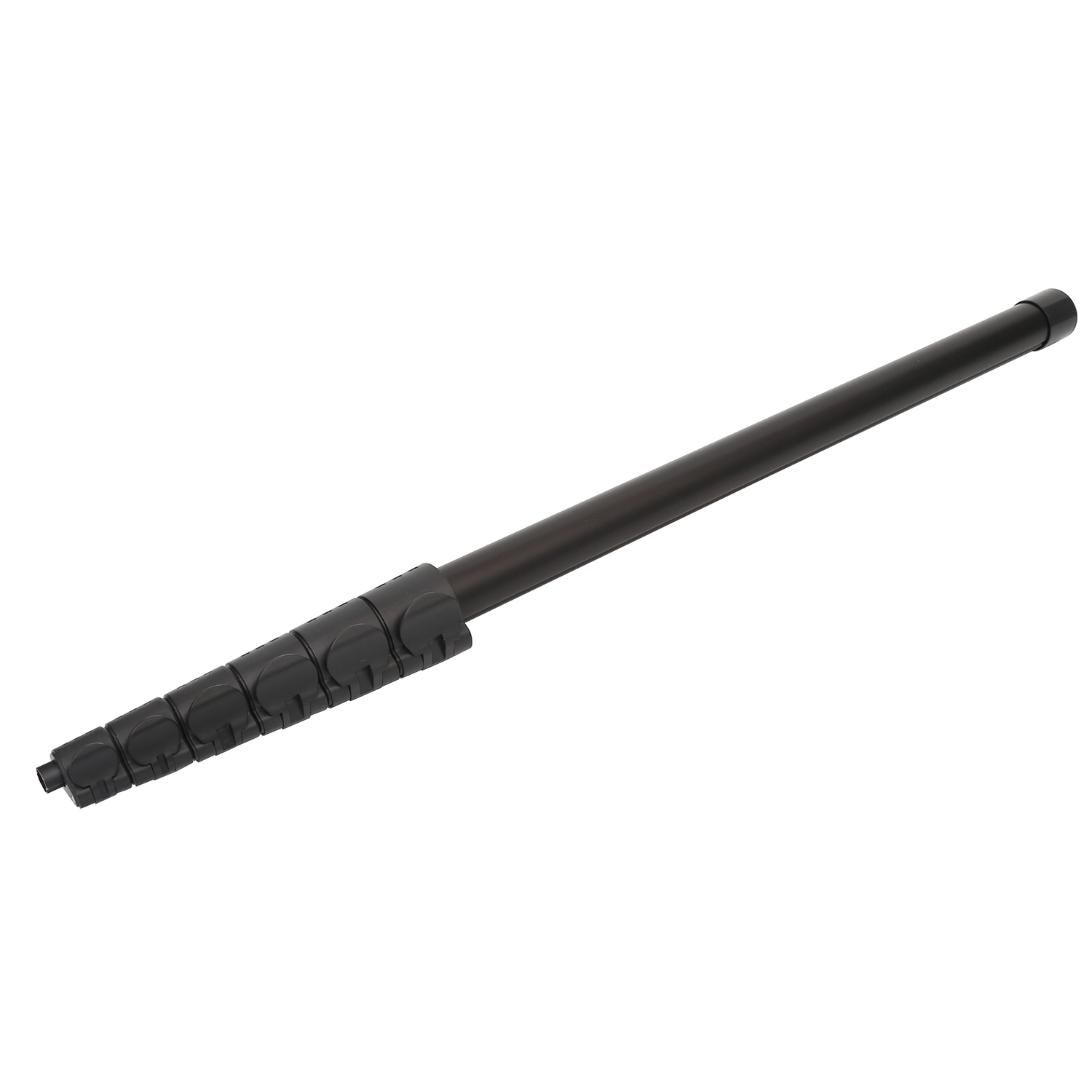
Consider how you will transport the equipment daily. Tight-space maneuverability acts as a key filter during procurement. You must choose between a 2-section or a 5-section build based on storage space. Five sections collapse into a much smaller footprint. You can store them inside small utility vans easily.
However, five sections require more locking mechanisms. This adds overall weight and complexity. Two sections offer higher rigidity with fewer failure points. Yet, they require long truck beds for transport. Evaluate your fleet vehicles before making a final decision.
Standard catalogs do not cover every industrial scenario. You must assess off-the-shelf limitations rigorously. Identify distinct triggers for customization before settling for inadequate tools.
Proprietary tool heads often require unique mounting solutions. Standard threaded tips cannot secure heavy industrial scanners or specialized robotic arms securely. Unusual collapsed-to-extended ratios also demand specialized engineering. Perhaps you need a unit that fits in a tiny backpack but extends forty feet. Extreme environmental requirements will also dictate custom material adjustments.
You need seamless integration into existing equipment fleets. Standard threads rarely match proprietary tooling grips perfectly. Specifying a Custom aluminum telescopic pole solves this integration problem. Engineers can design proprietary quick-release adapters specifically for your brand.
They can also machine custom outer diameters (OD). This matches the pole exactly to your existing tooling handles. Ergonomics improve drastically when the pole feels like a native extension of the tool. Do not compromise on the connection point.
Evaluate custom hard-coat anodizing. This specific treatment dramatically increases surface hardness. Standard anodizing provides basic protection, but hard-coat penetrates deeper into the metal. It survives intense daily friction.
You might also consider specialized powder coating options. Exceptional chemical resistance is crucial in harsh factories. Custom colors also help you meet specific color-coding requirements. You can designate red units for hazardous areas and blue units for cleanrooms. This simplifies safety compliance across large facilities.
| Treatment Type | Primary Benefit | Best Industrial Use Case |
|---|---|---|
| Standard Anodizing | Basic corrosion resistance | General indoor tooling, light outdoor use |
| Hard-Coat Anodizing | Extreme abrasion resistance | Heavy construction, repeated friction |
| Powder Coating | Chemical resistance and color coding | Chemical plants, safety-zoned facilities |
Evaluating the product design is only half the battle. You must vet the manufacturing partner thoroughly. A brilliant design fails if the factory cuts corners during production.
Require verifiable load-testing documentation immediately. Never accept vague promises regarding structural limits. Ask for detailed engineering reports. Demand actual lifecycle cycle-testing data for all locking mechanisms.
This proves the locks survive repeated daily abuse. A lock might hold perfectly on day one. You need to know if it holds after five thousand cycles. Transparent suppliers provide these testing documents willingly.
Evaluate the manufacturer’s minimum order quantities (MOQs). Custom builds often carry high upfront volume requirements. You must ensure their MOQs align financially with your budget. Do not get trapped into buying a ten-year supply at once.
Also, assess their actual capacity to scale up production. They must support massive fleet rollouts seamlessly. Ask about their raw material sourcing. Delays in aluminum extrusion will delay your entire tooling deployment.
Look closely for clear terms on structural warranties. Avoid contracts filled with vague exclusionary language. Acceptable tolerance variations in extrusion are highly technical details. You must clarify these exact tolerances before signing a contract.
If the tube diameter varies by even a fraction of a millimeter, the locks will fail. High defect rates cause severe delays in your operations. Establish a strict Acceptable Quality Limit (AQL) with the supplier upfront.
We highly recommend initiating a technical consultation with an engineering team today. Request a physical prototype sample from your chosen supplier. This action allows you to validate actual deflection and locking tension in your specific facility. Real-world testing always outperforms theoretical calculations. Take the time to test thoroughly before committing to a full fleet rollout.
A: Load capacity depends strictly on wall thickness, tube diameter, and the specific alloy. The angle of use also changes the limit drastically. Vertical compression handles far more weight than horizontal cantilever positions. We strongly suggest consulting the manufacturer load charts for precise structural figures.
A: Yes, but they require specific marine-grade anodizing. Bare metal corrodes quickly in harsh saltwater conditions. You also face severe galvanic corrosion near the joints. We advise crews to rinse the locking mechanisms with fresh water daily. This simple maintenance routine prevents salt crystal buildup and mechanical jamming.
A: Standard anodizing provides basic corrosion resistance and aesthetic color. It works well for light-duty applications. Hard-coat anodizing creates a significantly thicker, denser oxide layer. This delivers exceptional abrasion resistance. We highly recommend hard-coat finishes for heavy industrial tooling where rough handling occurs constantly.