English
Views: 0 Author: Site Editor Publish Time: 2026-07-11 Origin: Site
Choosing the wrong extension pole material leads to premature failure. It often causes serious user fatigue. It can even create compliance issues in regulated industries. The core conflict almost always comes down to a tough tradeoff. Buyers must choose between structural rigidity and ergonomic weight. Stainless steel offers incredible strength and impact resistance. Aluminum provides a lightweight profile for extended reach.
This guide provides a verifiable, specification-based framework. We will help buyers evaluate these two primary materials accurately. You will learn how to match physical properties against specific load requirements. We cover environmental exposure risks and daily usage frequency constraints. You can confidently select the exact specification your operational environment demands.
Procurement errors usually stem from misunderstanding environmental demands. You must assess how and where the equipment operates. A rigorous evaluation prevents early equipment retirement. It also ensures user safety during prolonged operations.
Identify the Primary Point of Failure
You should map past equipment failures before buying new stock. Look at your historical data. Did previous poles bend under lateral stress? Did they seize at the joints due to internal corrosion? Perhaps they caused user injury from excessive weight and fatigue. Identifying these exact failure points dictates your material requirements. A bent tube cannot retract. A corroded joint seizes permanently. User fatigue leads directly to dropped equipment.
Defining Success
A successful purchase aligns physical properties with specific use-case constraints. You must balance continuous operational hours against the maximum static load. An industrial inspection tool requires absolute rigidity. Conversely, a window-washing extension demands minimal weight for overhead use. Success means the tool performs reliably over its intended lifecycle without degrading.
The Role of Locking Mechanisms
Material choice directly impacts locking reliability. You must evaluate how twist-locks, cam-locks, or spring buttons interact with metal hardness. These locks undergo thousands of cycles. Harder metals resist wear from friction locks. Softer metals can develop grooves over time. This wear leads to slipping collars and sudden collapses.
Stainless steel represents the absolute pinnacle of structural integrity. It dominates heavy-duty sectors. Engineers specify it when failure is not an option. It handles brutal conditions effortlessly.
Material Reality
Manufacturers typically use 304 or 316-grade alloys for a standard stainless steel telescopic pole. The 304 grade contains high levels of chromium and nickel. This composition prevents standard atmospheric oxidation. The 316 grade adds molybdenum. This addition makes it highly resistant to chloride pitting. Both grades withstand severe impact and extreme temperatures.
Performance Advantages
Acknowledged Limitations
The material does have physical boundaries. It is considerably heavier than aluminum. This density limits the viable maximum extension length. A user will experience rapid fatigue if they hold a heavy pole overhead. Additionally, the raw material requires more complex manufacturing processes.
High-Value Implementations
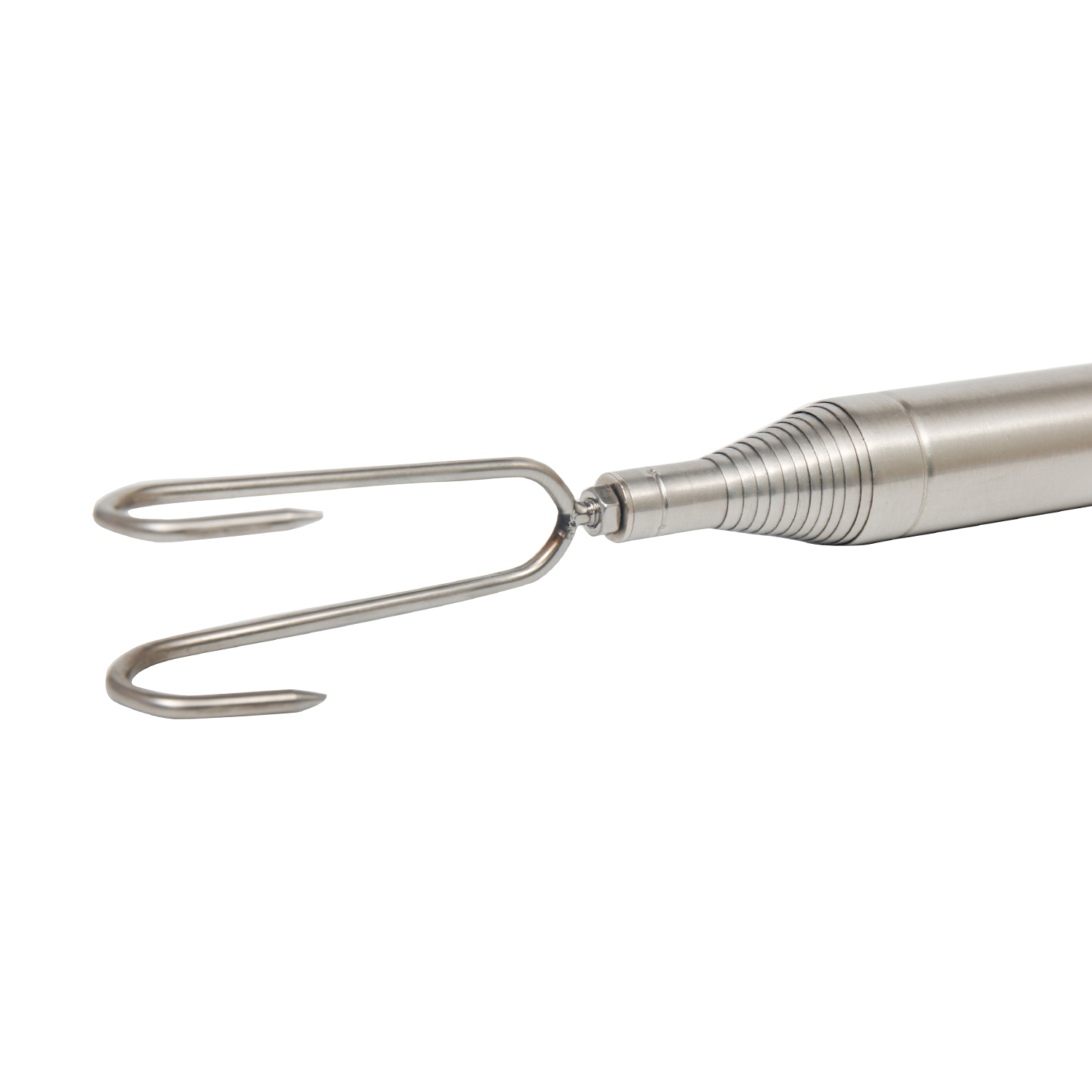
Heavy industries rely heavily on this metal. Marine workers use it for equipment retrieval in harsh saltwater. Culinary professionals demand it for outdoor cooking tools. It is the standard choice for a BBQ telescopic pole fork. Tactical teams utilize it for heavy-duty vehicle inspection mirrors. In these scenarios, rigidity trumps weight.
Best Practices & Common Mistakes
Always rinse your 304-grade equipment with fresh water after saltwater exposure. A common mistake is selecting steel for overhead tasks exceeding 20 feet. The excessive weight will cause severe shoulder strain.
Aluminum dominates the commercial maintenance sector. It provides unmatched vertical reach. The material allows a single operator to manage massive extensions safely.
Material Reality
Manufacturers commonly utilize 6061 or 6063 extruded aluminum alloys. The 6061 alloy includes magnesium and silicon. This combination offers an excellent yield strength. However, the metal relies entirely on anodizing to protect against surface oxidation. Unsealed aluminum degrades rapidly in harsh conditions.
Performance Advantages
Acknowledged Limitations
The softer metal is susceptible to denting. Excessive lateral force will bend the tubes. Once bent, telescopic nesting is permanently compromised. Furthermore, raw aluminum can cause skin discoloration. The blackening effect occurs if the tube is not properly anodized. Unlike a heat-resistant stainless steel barbecue fork, aluminum tools cannot withstand open flames.
High-Value Implementations
Commercial window washing teams rely on this metal. Solar panel cleaning crews use it daily. It excels in pool skimming and routine aquatic maintenance. Outdoor enthusiasts use it for portable flagpoles and ultralight tent pitching.
Best Practices & Common Mistakes
Specify Type II or Type III anodization for any commercial purchase. A frequent mistake is using unsealed aluminum in heavily chlorinated pools. The chemical reaction degrades the metal within months.
You must evaluate materials across specific performance metrics. Subjective opinions do not prevent equipment failure. Rely on verifiable engineering dimensions.
The material comparison chart below outlines the exact trade-offs between the two metals.
| Performance Metric | 304 / 316 Stainless Steel | 6061 / 6063 Aluminum |
|---|---|---|
| Base Density | High (~8.0 g/cm³) | Low (~2.7 g/cm³) |
| Max Practical Reach (Overhead) | Under 15 Feet (Ergonomic limit) | Up to 30+ Feet |
| Heat Tolerance | Exceptional (Food Safe) | Poor (Rapid heat transfer) |
| Lateral Deflection | Minimal bowing at full stretch | Requires thicker walls to reduce sag |
Evaluation metric: Measure the visual "sag" at maximum extension. Aluminum requires thicker tube walls to match the rigidity of thinner stainless steel. This design choice equalizes weight at certain lengths. However, it significantly increases the outer diameter. A larger diameter can become difficult for users to grip continuously. Steel maintains a slim profile while resisting horizontal deflection.
Evaluation metric: Evaluate the specific chemical exposure. Chlorine and salt water degrade unsealed aluminum quickly through galvanic corrosion. The metal pits and eventually seizes at the nesting joints. Stainless steel requires minimal maintenance. A simple fresh-water rinse maintains structural integrity perfectly. The 316 grade completely ignores marine environments.
Evaluation metric: Assess the collar friction over time. Friction locks wear down softer aluminum tubes faster. They create microscopic grooves. This wear reduces locking power. If you use aluminum, specify positive-locking mechanisms. Spring buttons or metal pins extend lifespan dramatically. Steel handles heavy-duty twist-locks effortlessly due to superior surface hardness.
Evaluation metric: Track heat transfer rates and surface porosity. Aluminum transfers heat rapidly. It degrades or warps near open flames. Stainless steel retains structural integrity near extreme heat. It remains non-porous under thermal stress. This characteristic makes it the only compliant choice for culinary extensions or medical-grade cleaning tasks.
Decision paralysis often delays critical equipment upgrades. Use this sequential filtering process. It removes guesswork from your final purchase order.
There is no universal "better" material. You only find the right specification for the operational environment. Ignoring environmental constraints guarantees equipment failure.
Over-index on rigidity and chemical resistance for ground-level tasks. Heavy-duty or food-safe applications strictly demand stainless steel. Conversely, prioritize ergonomics and reach for overhead maintenance. Continuous-use tasks at extreme heights require aluminum.
Review the exact payload weight your pole must support. Check the maximum extension distance needed. Finalize these two metrics before submitting a purchase order.
A: No. Aluminum conducts heat too quickly. It can melt or warp at high temperatures. It poses a severe burn risk to the user. A stainless steel telescopic pole is absolutely required for culinary applications.
A: This is surface oxidation transferring to your skin. If you purchase aluminum, verify it features a high-quality anodized finish. Anodizing prevents this degradation completely. Stainless steel does not have this issue.
A: They are highly resistant. However, lower grades like 400 series or 201 can show surface rust. This happens if they face harsh chemicals without cleaning. Specify 304 or 316 grade for maximum protection.
A: Spring-loaded push buttons work best on aluminum. They prevent internal tube wear. Heavy-duty twist locks or cam locks are highly effective on steel. The metal's hardness prevents friction degradation.