English
Views: 0 Author: Site Editor Publish Time: 2026-07-03 Origin: Site
Sourcing hardware from overseas offers immense margin advantages for buyers. However, it also carries distinct quality and compliance risks you must navigate carefully. Substandard telescopic poles routinely suffer from premature lock failure, bending under heavy loads, and rapid surface corrosion. These critical failures inevitably lead to costly product returns and severe brand damage in highly competitive markets.
Our primary objective is to provide procurement managers and product developers an evidence-based checklist. We will guide you through vetting potential manufacturers and rigorously evaluating technical specifications. You will learn exactly how to secure reliable agreements and spot supply chain red flags early. By implementing these practices, you can confidently protect your bottom line and ensure long-term product integrity for your end-users.
Aluminum alloys dictate the baseline performance of any extension tool. Manufacturers primarily use 6063 and 6061 series alloys. You must understand their differences to make informed procurement decisions. Industry experts widely consider 6063-T5 or T6 the gold standard for extrusion profiles. It offers an exceptional balance of tensile strength and surface finish quality. This grade extrudes cleanly, allowing factories to create precise tolerances for sliding tubes.
Alloy 6061 offers slightly higher yield strength. Heavy-duty construction equipment sometimes requires this grade. However, 6061 is harder to extrude into complex, thin-walled shapes. Always verify factory material sources. Some suppliers cut costs by melting recycled aluminum scrap. Recycled scrap introduces impurities. These impurities create brittle poles prone to snapping under sudden stress.
| Alloy Grade | Primary Characteristic | Best Application | Surface Finish Quality |
|---|---|---|---|
| 6063-T5/T6 | Excellent extrudability and balance | Standard to heavy-duty telescopic poles | Smooth, ideal for anodizing |
| 6061-T6 | Maximum yield strength | Extreme load-bearing tools | Slightly rougher, harder to extrude |
| Recycled Scrap | Inconsistent composition | Avoid (High risk of failure) | Prone to pitting and defects |
Wall thickness directly controls tube rigidity. You need established baseline wall thickness ratios based on the intended maximum length. A short, lightweight duster pole might function perfectly using 0.8mm walls. Conversely, heavy-duty applications demand a minimum of 1.0mm to 1.5mm. Painting high ceilings or cleaning second-story windows requires substantial structural integrity.
You face a constant trade-off between weight and rigidity. Thicker walls prevent severe deflection when fully extended. Excessive weight, however, causes user fatigue quickly. Work closely alongside your supplier to calculate optimal Outside Diameters (OD) for each nested section. Proper OD stepping ensures the pole remains stiff without feeling unnecessarily heavy.
Bare aluminum oxidizes rapidly. You must mandate strict surface treatment standards. Define a minimum micron thickness for all anodized coatings. Standard applications usually require 10 to 15 microns. Marine environments or water-fed cleaning systems demand 15 to 20 microns to prevent pitting.
Anodizing creates a hard exterior shell. This shell protects the metal from harsh cleaning chemicals and saltwater. It also allows smooth sliding between nested sections. Poor anodizing leads to sticky, jammed tubes over time.
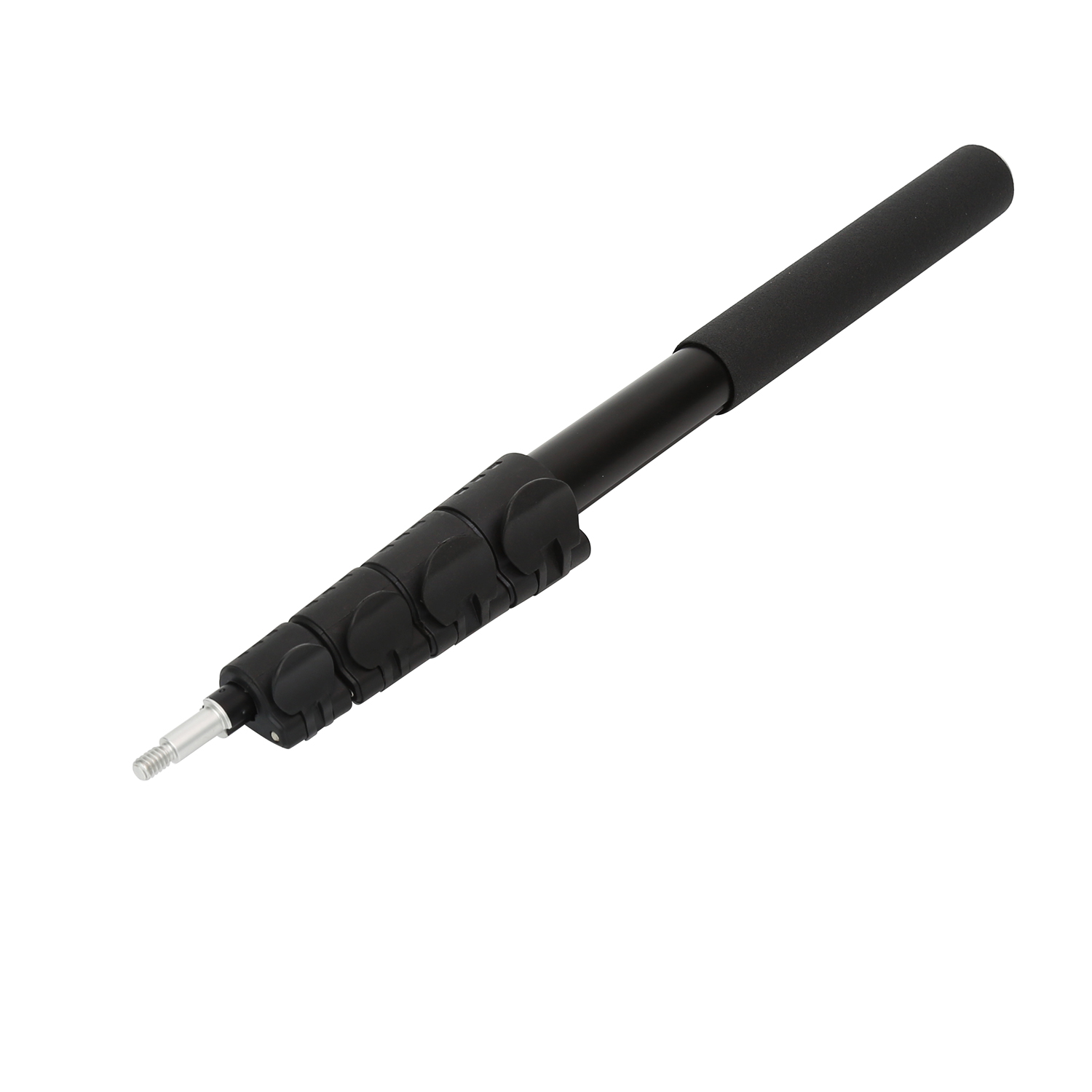
The locking mechanism serves as the heart of any extension tool. You must evaluate twist locks for lightweight, low-dust environments. Twist locks use internal friction collars. They offer a sleek, snag-free exterior. Painters and indoor cleaners prefer them for their simple, intuitive operation. However, internal twist locks often jam if fine dust or grit enters the tube.
Evaluate flip-cam locks for heavy-duty, high-debris environments. Flip-cam locks rely on an external lever system. They clamp down securely onto the inner tube. Users gain immediate visual confirmation when the lock engages. Professional window washers and pool technicians prefer flip-cams. They can adjust them easily while wearing thick gloves.
Lock collars, grips, and end caps heavily influence perceived product quality. Identify the importance of using virgin nylon or ABS plastics. Some manufacturers substitute cheap recycled plastics to lower bids. Recycled plastics degrade under ultraviolet light exposure.
Recycled plastics become dangerously brittle. A cracked lock collar renders the entire tool useless instantly.
Your product must integrate seamlessly into the end-user’s existing toolkit. Detail the exact requirements for universal fittings. When designing the tip, you should specify a standard male thread telescopic pole adapter. The ACME thread is the dominant standard across North America. It guarantees effortless compatibility across standard cleaning brushes, paint rollers, and pool nets. Avoid proprietary thread pitches. Proprietary threads frustrate buyers and severely limit your market reach.
Differentiation matters in crowded markets. Outline how to assess a factory’s ability to open new molds. Smooth circular tubes often spin during vigorous scrubbing tasks. Custom ribbed profiles completely prevent tube spinning. They interlock structurally to keep the attached brush or squeegee perfectly aligned.
Ask potential suppliers about their in-house tooling capabilities. Factories owning their extrusion dies can iterate designs much faster. They can quickly modify a profile to add structural reinforcement channels inside the tube.
Never commit blindly to a mass production run. Set clear expectations for sample production upfront. A capable manufacturer typically requires 7 to 14 days to produce functional prototypes. This timeline assumes they already hold the required extrusion dies. Custom molds extend this timeline significantly.
Use the prototyping phase to test communication speed. Evaluate their willingness to adjust tolerances. If a supplier struggles to deliver an accurate sample, they will inevitably fail during mass production.
Reputable manufacturing partners maintain extensive documentation. Verify their ISO 9001 factory certification status early. ISO certification demonstrates standardized quality management processes. It proves they systematically document defects and implement corrective actions.
You must also request independent material test reports from agencies like SGS or TUV. These documents confirm the actual alloy composition. They validate the supplier's vertical load-bearing claims. Relying solely on internal factory data is a severe procurement risk.
Understanding cost structures gives you immense negotiation power. Break down the primary cost drivers behind the product. Aluminum spot prices dictate the raw material baseline. Locking mechanism complexity adds significant assembly labor. Standard twist locks cost less to assemble than multi-part flip-cam systems.
Order volume heavily dictates your final pricing structure. Explain how tiered Minimum Order Quantities (MOQs) impact the per-unit price. Setup times for extrusion runs are expensive. Ordering larger batches of wholesale telescopic poles amortizes this setup cost efficiently. Collaborate closely to forecast volumes. This alignment helps secure the most favorable pricing tiers.
Logistics can quickly destroy your profit margins. Address the specific logistical challenges of shipping long, cylindrical items. Standard pallets do not accommodate extended lengths easily. They waste valuable shipping container space if packed incorrectly.
Recommend custom corrugated packaging for high-end retail products. For bulk B2B distribution, use thick protective poly sleeves. Ensure the factory packs the cartons tightly to prevent movement. Loose items suffer severe denting and scratching during turbulent LCL or FCL sea freight transit. Specify drop-test standards for the outer master cartons to survive warehouse handling.
Never authorize final payments before completing a thorough inspection. Define acceptable defect rates using standard AQL (Acceptable Quality Limit) metrics. Distinguish clearly between cosmetic scratches and functional failures. A tiny scratch on the inner tube might classify as a minor defect. A faulty flip-cam lever represents a critical failure.
Static inspections alone cannot predict real-world longevity. Recommend requesting hard data on lock-cycle testing. How many times can the user engage the lock before the internal mechanism slips? A premium mechanism should easily survive 10,000 engagement cycles.
Require vertical load-bearing tests. Suspend a specified weight from the fully extended tip. Measure the deflection curve. The tool must return to absolute straightness once you remove the weight. Permanent bending indicates insufficient wall thickness or improper alloy tempering.
Experience teaches buyers to recognize warning signs early. Warn your team against suppliers offering prices significantly below the market average. Abnormally low prices almost always indicate perilously thin walls. They might also indicate the use of cheap scrap metal. Either scenario guarantees mass product failures.
Caution against trading companies falsely claiming to be direct manufacturers. Always request comprehensive factory audit reports. A true manufacturer gladly provides factory photos, machine lists, and third-party audit certificates. Evasive answers regarding facility locations strongly suggest you are dealing with a middleman.
Successful procurement requires disciplined vetting and uncompromising standards. Choose suppliers based on verified material specs rather than unit price alone. Evaluate their transparent testing protocols and robust OEM capabilities carefully. A reliable manufacturing partner protects your brand reputation through consistent, high-quality production runs.
Take proactive next steps today to secure your supply chain. Request a production sample of the specific aluminum telescopic pole model you intend to market. Specify your desired lock type and exact thread attachment dimensions clearly. Finally, arrange an independent factory audit to verify their machinery and quality control processes before signing any long-term agreements.
A: The standard Minimum Order Quantity typically ranges between 500 and 1000 units. This volume justifies the factory setup time for extrusion and anodizing. Highly customized profiles or unique colors may require MOQs exceeding 2000 units to offset new tooling costs.
A: Specify the use of die-cast zinc, reinforced virgin nylon, or metal-riveted tips. Avoid cheap, glued plastic tips entirely. A secure metal rivet through the aluminum tube provides maximum lateral strength when users apply heavy scrubbing pressure.
A: Aluminum is highly cost-effective and impact-resistant for most commercial applications. Carbon fiber provides ultra-light, rigid performance for extreme high-reach tasks (like multi-story window cleaning). However, carbon fiber costs significantly more and shatters easily under sharp lateral impacts.
A: Yes. Reputable OEM suppliers can easily extrude ribbed, hexagonal, or oval tube profiles. These non-circular shapes provide excellent anti-rotational stability. They ensure your attached tools remain perfectly aligned during rigorous use.